Something about Agent Skills
近期调研了 Anthropic 推出的 Agent Skills 功能,将调研内容整理分享。
注意:
- 本文中默认通用大模型针对通用任务,agent 针对特定领域,而 skills 则针对任务。 (这与 Anthropic 官方定义的 Agent 为通用任务,skill 针对特定领域略有出入,但不影响核心论点。)
- 由于 Anthropic 代表产品为 Claude Code,因此本文中可能会混用 Anthropic 和 Claude,意思相同。
Agent Skill 概述
AI 整理,参考下简单了解下其发展即可
| 时间 | 事件 | 说明 / 详细内容 | 进展 |
|---|---|---|---|
| 2025/10/16 | Anthropic 正式发布 Agent Skills 功能 | Anthropic 在其官网与工程博客上首次公开发布 “Agent Skills”(也称 Claude Skills)功能。Skills 是包含指令、脚本与资源的文件夹结构,可让 Claude 动态加载并高效执行特定任务。 | 官方发布公告 |
| 2025/10/16-17 | 媒体报道与行业关注 | 技能功能在多家媒体获得报道,包括行业媒体介绍其作为 Claude 执行业务任务的模块化能力,以及在 Claude.ai、Claude Code、API 等平台的初期可用性。 | 媒体报道 |
| 2025/10/20 | 社区反馈与 SDK 支持讨论 | 在开发者社区(如 Reddit)出现初步讨论,关注 Claude Agent SDK 与 Skills 的集成支持情况;确认官方文档描述支持多平台。 | 社区反馈 |
| 2025/10/21 | 社区生态建设:MCP Server for Skills | 开源者发布基于 Anthropic Skills 的 MCP Server,让 Skills 能跨平台运行、连接到如 Cursor 等工具,提升生态互操作性。 | 社区开发 |
| 2025/12/18 | Agent Skills 发布为开放标准(Open Standard) | Anthropic 正式把 Agent Skills 拆分为开放标准,发布规范与 SDK,使得 Skills 能跨平台、跨供应商采用,而不仅限于 Claude 产品线。 | 官方升级 |
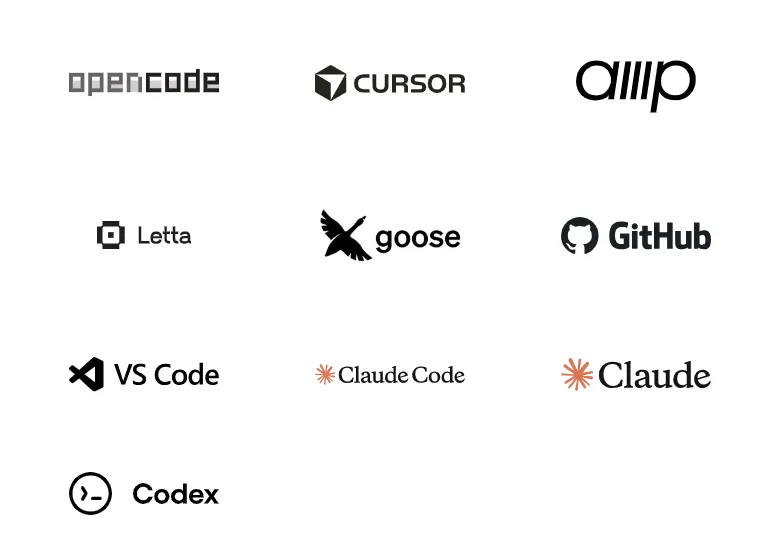
| 2025-12 中下旬 | 多方采用与社区拓展 | VS Code、Cursor 等开发工具显示早期支持 Agent Skills 标准;GitHub 上有官方与社区示例 Skill 库发布,涵盖文档处理、开发工具等领域。 | 社区与产业响应 |
| 2025-12-18 之后 | 行业报道强调开放标准的重要性 | 多个科技媒体与分析报道聚焦于 Skills 开放标准对于 AI agent 生态的推动意义,并探讨其跨平台潜力。 | 产业分析 |
| 2026-1-19 | Coze 2.0 正式支持 Skills | Coze 2.0 推出 Skills、长期任务对以往经验进行封装,还全球首次上线了技能商店。 | 友商跟进 |
| 2026-1-30 | MemOS 跟进 Skill | MemOS 已支持 Skill,用于将长期对话中沉淀的任务经验,转化为可复用、可执行的 Agent 能力单元。 | 竞品发力 |
Why Agent Skill?
- Claude is powerful, but real work requires procedural knowledge and organizational context
- Agents with access to a set of skills can extend their capabilities based on the task they’re working on.
面向组织场景,针对过程知识,扩展 Agent 在特定任务上的能力。
What is Agent Skill?
December 18, 2025 cluade推出跨平台开放标准Agent Skills
Dev 视角
一组封装的经验/知识,以文件目录的形式呈现。
my-skill-name/
├── SKILL.md (required,Yaml头 + md内容)     # Required: instructions + metadata
├── reference/ (optional documentation)       # Optional: documentation
├── examples.md (optional examples)
├── scripts/                                  # Optional: executable code
│   └── helper.py (optional utility)
└── assets/                                   # Optional: templates, resources
└── template.txt (optional template)| 文件名 | 说明 | 要求 |
|---|---|---|
| SKILL.md | 核心文档,包括元信息(默认装载)和指令(触发时装载) | 必选 |
| references/ | 可读的额外文档(必要时) | 可选 |
| scripts/ | 运行所需的可执行代码 | 可选 |
| assets/ | 包含所需的静态资源 | 可选 |
核心文件 SKILL.md 示例
---
name: your-skill-name
description: Brief description of what this Skill does and when to use it
license: Apache-2.0
metadata:
  author: example-org
  version: "1.0"
compatibility: Requires git, docker, jq, and access to the internet
allowed-tools: Read, Grep, Glob  # (非必选,仅 Claude Code 支持,控制内置工具的调用)
---

# Your Skill Name

## Instructions

Provide clear, step-by-step guidance for Claude.

For advanced usage, see [reference.md](reference.md).

Run the helper script:

```bash
python scripts/helper.py input.txt
```

## Examples

Show concrete examples of using this Skill.
使用时,由 LLM 自动触发,并渐进式展开。
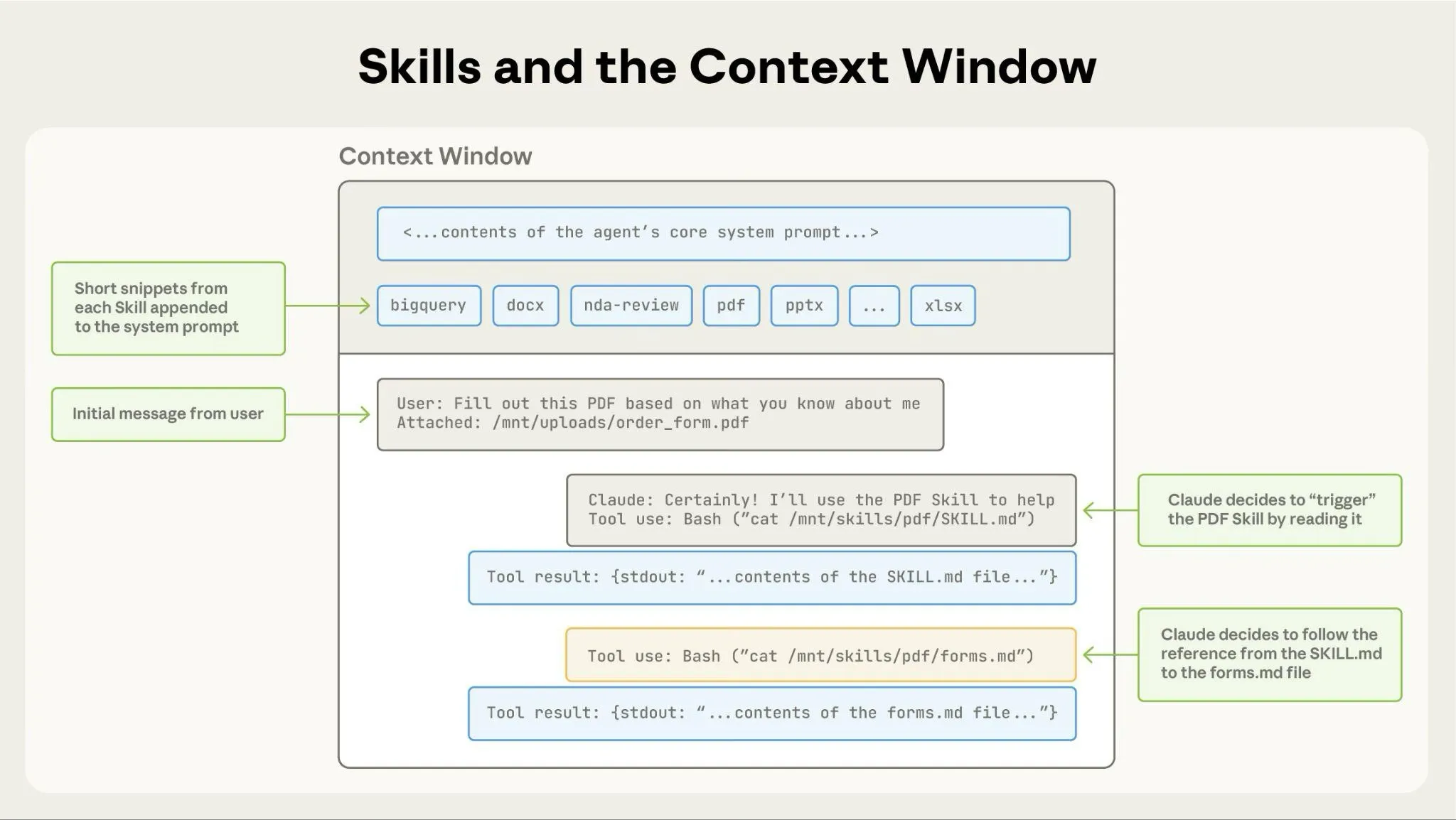
推荐的集成方式
- Filesystem-based agents operate within a computer environment (bash/unix) and represent the most capable option. Skills are activated when models issue shell commands like
cat /path/to/my-skill/SKILL.md. Bundled resources are accessed through shell commands. - Tool-based agents function without a dedicated computer environment. Instead, they implement tools allowing models to trigger skills and access bundled assets. The specific tool implementation is up to the developer.
兼容 Skills 需求
- Discover skills in configured directories
- Load metadata (name and description) at startup
- Match user tasks to relevant skills
- Activate skills by loading full instructions
- Execute scripts and access resources as needed
产品视角
Agent Skills are modular capabilities that extend Claude’s functionality.
Each Skill packages instructions, metadata, and optional resources (scripts, templates) that Claude uses automatically when relevant.
通过封装指令、元信息、资源等为 Agent 模块化提供能力/增强(可认为是轻量级、Agentic workflow)
一些 Agent Skills 的 demo
<u>其中 skill-creator 尤其值得注意,其一只脚已经迈入了 Self-Evolving</u>
关于 Self-Evolving AI Agent 感兴趣的可阅读:
Fang J, Peng Y, Zhang X, et al. A comprehensive survey of self-evolving ai agents: A new paradigm bridging foundation models and lifelong agentic systems[J]. arXiv preprint arXiv:2508.07407, 2025.
Coze 对其也进行了跟进,且水准很高。后续子标题会详细介绍
Claude Family
Claude.ai
https://www.youtube.com/watch?v=IoqpBKrNaZI&feature=youtu.be
Both pre-built Agent Skills and custom Skills:
- Pre-built Agent Skills: These Skills are already working behind the scenes when you create documents. Claude uses them without requiring any setup.
- Custom Skills: Upload your own Skills as zip files through Settings > Features. Available on Pro, Max, Team, and Enterprise plans with code execution enabled. Custom Skills are individual to each user; they are not shared organization-wide and cannot be centrally managed by admins.
Claude Code
- Only Custom Skills.
- Filesystem-based and don’t require API uploads.
| 类型 | 使用方式 |
|---|---|
| Personal Skills | 私人设置 |
| Project Skills | 与项目绑定 |
| Plugin Skills | 绑定在插件,用于共享 |
Claude Code 2.1.3 合并 slash command 和 skill 以降低用户理解成本:
https://github.com/anthropics/claude-code/blob/main/CHANGELOG.md#213
Claude API
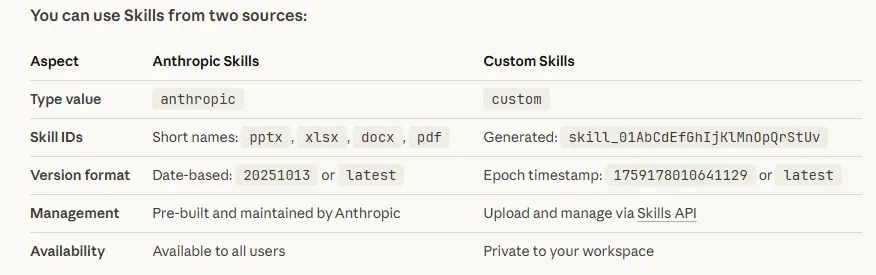
- Both pre-built Agent Skills and custom Skills.
- Specify the relevant
skill_idin thecontainerparameter along with the code execution tool.
- Specify the relevant
import anthropic

client = anthropic.Anthropic()

# Step 1: Use a Skill to create a file
response = client.beta.messages.create(
    model="claude-sonnet-4-5-20250929",
    max_tokens=4096,
    betas=["code-execution-2025-08-25", "skills-2025-10-02"],
    container={
        "skills": [
            {"type": "anthropic", "skill_id": "xlsx", "version": "latest"}
        ]
    },
    messages=[{
        "role": "user",
        "content": "Create an Excel file with a simple budget spreadsheet"
    }],
    tools=[{"type": "code_execution_20250825", "name": "code_execution"}]
)

# Step 2: Extract file IDs from the response
def extract_file_ids(response):
    file_ids = []
    for item in response.content:
        if item.type == 'bash_code_execution_tool_result':
            content_item = item.content
            if content_item.type == 'bash_code_execution_result':
                for file in content_item.content:
                    if hasattr(file, 'file_id'):
                        file_ids.append(file.file_id)
    return file_ids

# Step 3: Download the file using Files API
for file_id in extract_file_ids(response):
    file_metadata = client.beta.files.retrieve_metadata(
        file_id=file_id,
        betas=["files-api-2025-04-14"]
    )
    file_content = client.beta.files.download(
        file_id=file_id,
        betas=["files-api-2025-04-14"]
    )
    # Step 4: Save to disk
    file_content.write_to_file(file_metadata.filename)
print(f"Downloaded: {file_metadata.filename}")- 请求限制
- 每次请求最大skills数 = 8
- 上传skill最大尺寸8MB
- YAML格式限制(略)
- 执行容器限制
- 禁止网路通信
- 无运行时安装包
- 每次请求刷新容器
Claude Agent SDK
Supports custom Skills through filesystem-based configuration.
- Include “Skill” in your
allowed_toolsconfiguration - Configure
settingSources/setting_sourcesto load Skills from the filesystem
| 类型 | 使用方式 |
|---|---|
| Personal Skills | 私人设置 |
| Project Skills | 与项目绑定 |
| Plugin Skills | 绑定在插件,用于共享 |
import asyncio
from claude_agent_sdk import query, ClaudeAgentOptions

async def main():
    options = ClaudeAgentOptions(
        cwd="/path/to/project",  # Project with .claude/skills/
        setting_sources=["user", "project"],  # Load Skills from filesystem
        allowed_tools=["Skill", "Read", "Write", "Bash"]  # Enable Skill tool
    )

    async for message in query(
        prompt="Help me process this PDF document",
        options=options
    ):
        print(message)

asyncio.run(main())
OpenClaw
支持,并大量应用 Skills:
生效/覆盖策略
| 模式 | 来源 | 优先级(命名冲突覆盖) |
|---|---|---|
| Bundled skills | shipped with the install | 低 |
| Managed/local skills | ~/.openclaw/skills | 中 |
| Workspace skills | <workspace>/skills | 高 |
| Extra skills | ~/.openclaw/openclaw.json skills.load.extraDirs | 低 |
多 agent 场景
- 每个 agent 有其 workspace,其中的 skill 为 agent 独占
- 多 agent 可采用
extraDirs和ManagedSkill实现共享
格式/兼容性/特性
- 跟随 AgentSkills 的 spec
- 其解析器支持 skill 装载时过滤
---
name: nano-banana-pro
description: Generate or edit images via Gemini 3 Pro Image
metadata: {
    "openclaw": {
        "requires": {
             "bins": ["uv"],
             "env": ["GEMINI_API_KEY"],
             "config": ["browser.enabled"]
         },
        "primaryEnv": "GEMINI_API_KEY",
    },
}
---
Skill-creator
https://github.com/openclaw/openclaw/tree/main/skills/skill-creator
项目结构
skill-creator/
├── scripts/
│   ├── init_skill.py
│   ├── package_skill.py
│   └── quick_validate.py
├── license.txt
└── SKILL.md
SKILL.md 核心内容
---
name: skill-creator
description: Create or update AgentSkills. Use when designing, structuring, or packaging skills with scripts, references, and assets.
---

... 忽略一部分 ...

## Skill Creation Process

Skill creation involves these steps:

1. Understand the skill with concrete examples
2. Plan reusable skill contents (scripts, references, assets)
3. Initialize the skill (run init_skill.py)
4. Edit the skill (implement resources and write SKILL.md)
5. Package the skill (run package_skill.py)
6. Iterate based on real usage

... 忽略一部分 ...

### Step 6: Iterate

After testing the skill, users may request improvements. Often this happens right after using the skill, with fresh context of how the skill performed.

**Iteration workflow:**
1. Use the skill on real tasks
2. Notice struggles or inefficiencies
3. Identify how SKILL.md or bundled resources should be updated
4. Implement changes and test again
生态
提供公共 skills 托管注册平台: clawhub & clawhub CLI
Coze
调用
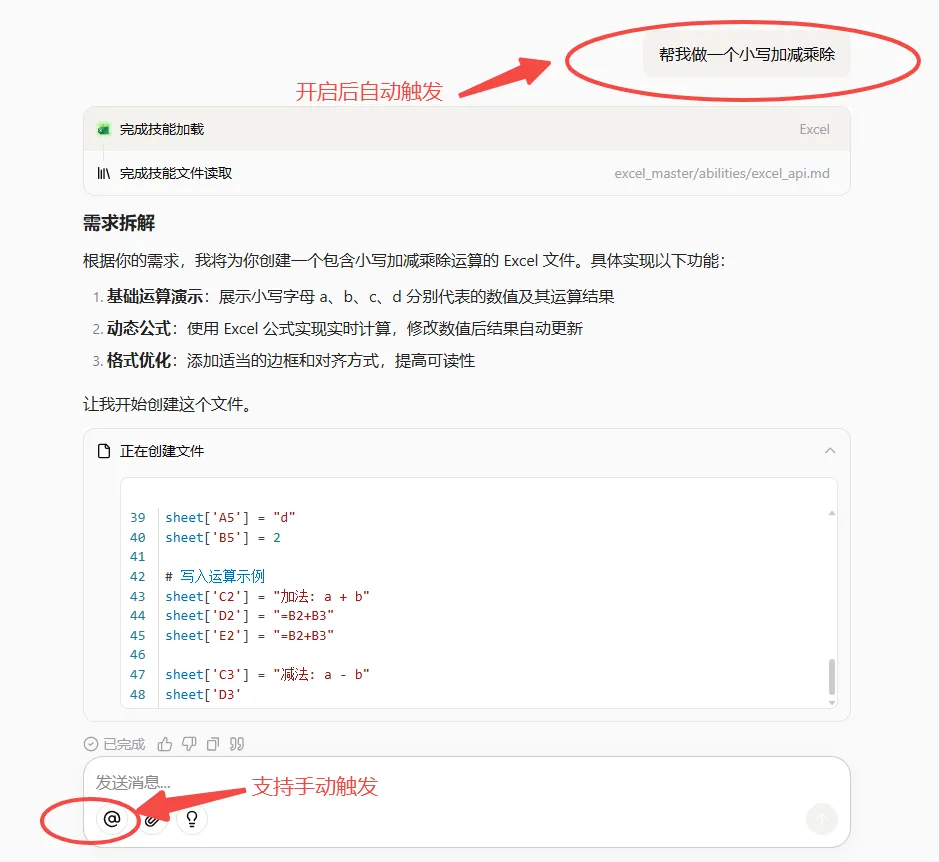
管理
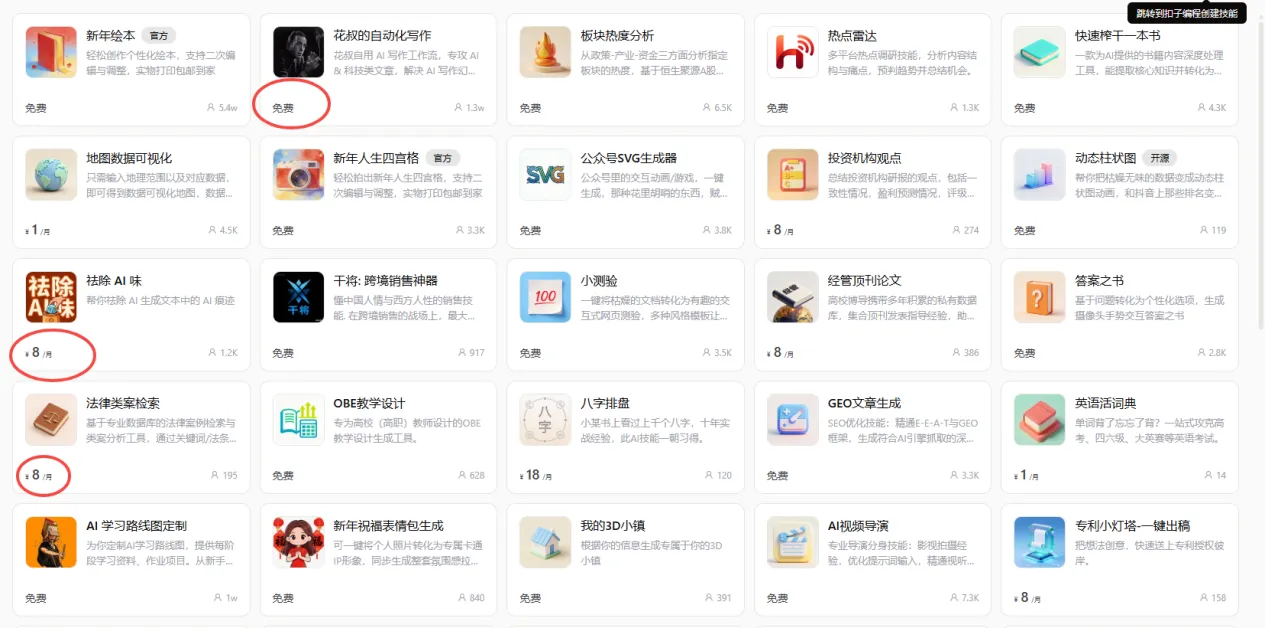
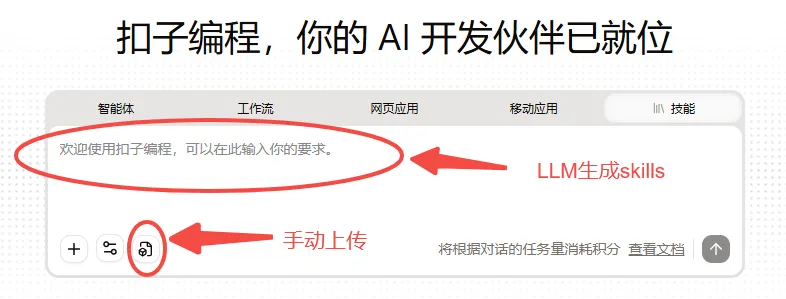
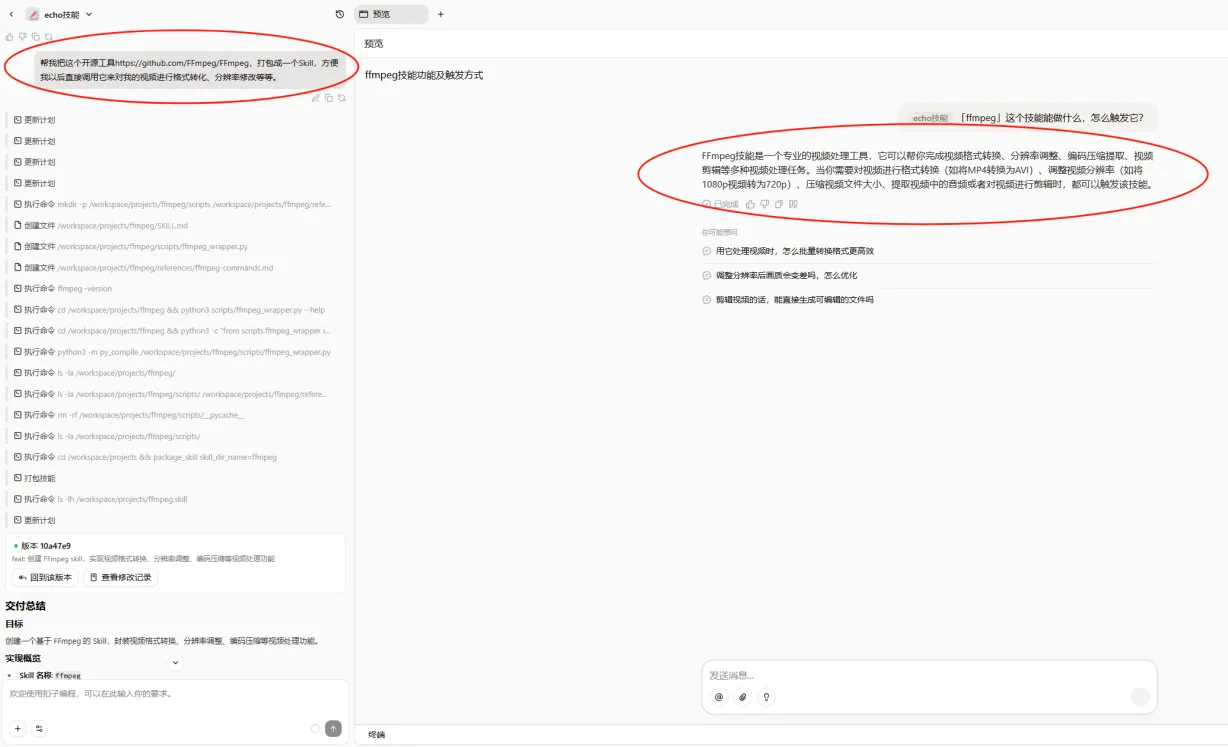
MemOS
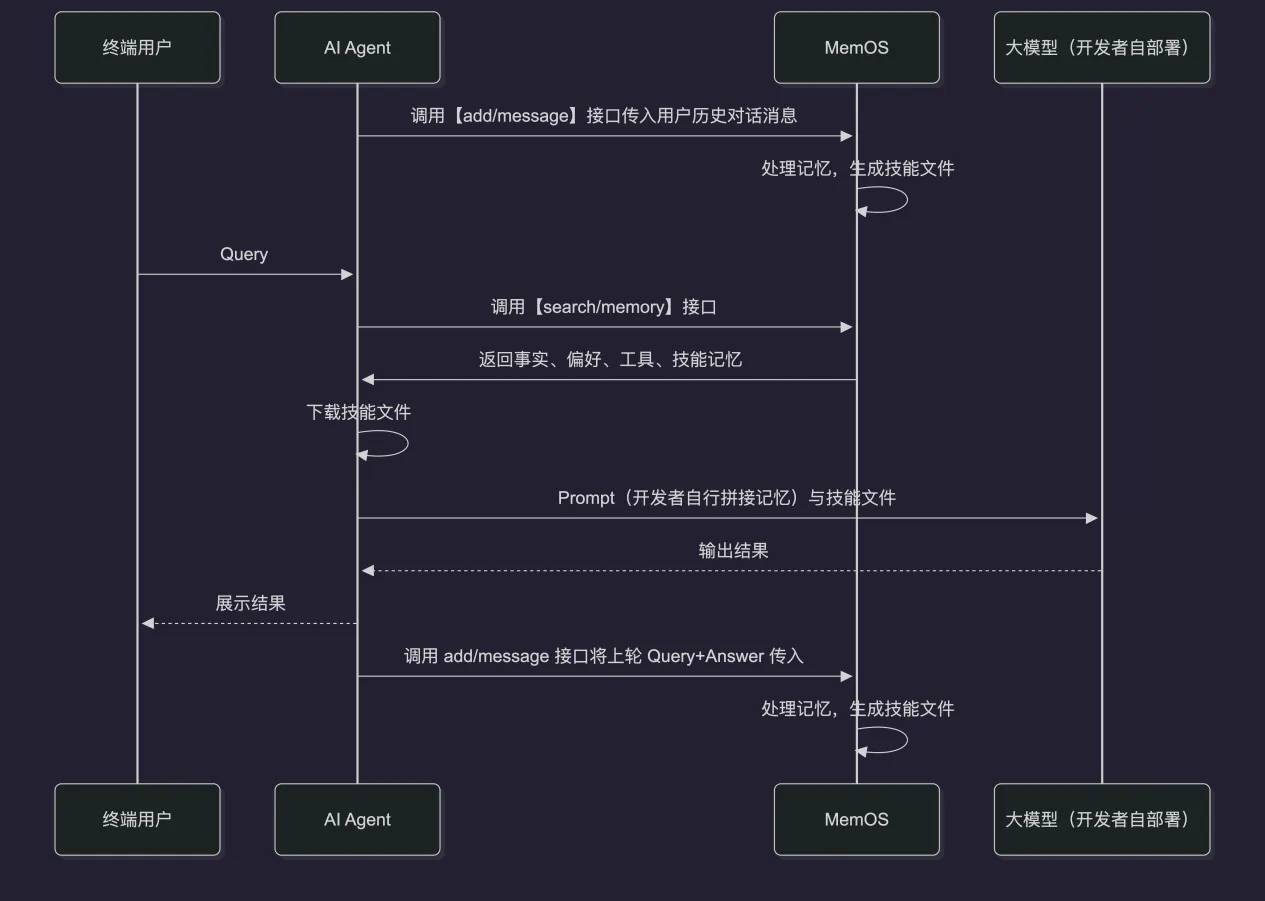
- 率先在记忆系统中引入 skill
- 将结构化记忆封装/转化为 Skill,为记忆在 LLM 中的拼接/使用提供了一个思路
当前 LLM 外挂记忆系统存在痛点:概念太多,dev 理解成本很高,合理使用难度大
其通过将记忆直接封装为 skill(直接固化记忆的使用模式)从而降低使用成本
- 某种意义上实现了 Claude 规划的自动评估/进化的 skill
# Add Messages
data = {
    "user_id": "memos_user_123",
    "conversation_id": "0127",
    "messages": [
      {"role": "user", "content": "下周我要去成都玩,帮我规划一个5天的出行计划,我喜欢不走回头路的特种兵出行,帮我标注路途中值得品尝的美食。"},
      {"role": "assistant", "content": "...此处省略..."},
      {"role": "user", "content": "我比较喜欢逛文化景点,商场什么的不太感兴趣。"},
      {"role": "assistant", "content": "...此处省略..."},
      {"role": "user", "content": "帮我在规划的时候,提前确认一下天气和温度,方便我准备行李。"},
      {"role": "assistant", "content": "...此处省略..."}
    ]
}
MemOS 接收到请求后,会依次完成以下处理,生成技能(Skill)文件:
- 智能切片:识别历史对话中的任务边界,切分出任务文本块
- 聚类提取:将同类型的任务文本块聚类,结合用户的历史记忆,提取出结构化的技能文本
- 技能转化:将技能文本转化为可运行、可被识别的 Skill 文件
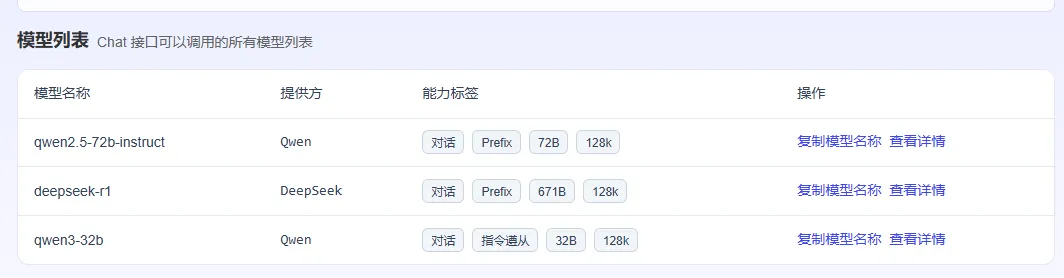
以上为 memOS 当前支持的模型列表,不一定 skill 采用的模型就在列表中,但八九不离十。
通用的 case,官网 demo 和实际跑出的不一致,可能是
- 为吞吐在效果上有所牺牲
- demo 仅为了说明
- 不同级别用户提供不同效果。
Skill.md 生成准实时,该条耗时 <10s
---
name: 旅行行程规划
description: 为用户设计个性化的旅行计划,包含行程安排和美食推荐
---

## Procedure

1. 确定旅行目的地和时间
2. 收集用户偏好和兴趣
3. 设计不走回头路的行程路线
4. 标注沿途值得品尝的美食
5. 根据用户兴趣添加景点或活动

## Experience

1. 优先选择用户兴趣相关的活动
2. 确保行程的多样性和灵活性

## User Preferences

- 用户偏好不走回头路的行程
- 文化景点优先于购物场所

## Examples

### Example 1

# 旅行计划示例

## 行程安排
- **第一天**: 到达目的地,入住酒店,参观文化景点A
- **第二天**: 游览文化景点B,品尝当地美食X
...

## 美食推荐
- **地点一**: 美食X,地址...
- **地点二**: 美食Y,地址...
Search Memory
# 请求
data = {
  "query": "清明节我打算去云南,帮我规划7天的行程。",
  "user_id": "memos_user_123",
  "conversation_id": "0301",
  "include_skill": True  # 开启召回skill
}

# 响应
{
    'skill_detail_list': [
        {
            'id': '0b3087f3-bc21-4f38-b45c-c8caec99e63b',
            # 对于不支持skill的客户端,给出value支持用户将其拼装为prompt
            'skill_value': {
                'name': '行程规划准备',
                'description': '在规划行程时,提前确认目的地的天气和温度,以便准备合适的行李',
                'procedure': '1. 确定目的地和行程日期 2. 查询目的地的天气预报和温度信息 3. 根据天气和温度调整行李清单 4. 准备和打包行李',
                'experience': ['提前了解目的地天气可以避免不必要的行李', '根据天气调整行李可以提高旅行的舒适度'],
                'preference': ['用户倾向于在行程规划中提前确认天气信息', '偏好根据天气信息进行行李准备'],
                'examples': ['### 行程规划准备示例\n\n- **目的地**: 北京\n- **行程日期**: 2023年10月1日 - 2023年10月7日\n- **天气预报**: 晴天,温度15-20°C\n- **行李清单**:\n  - 轻便外套\n  - 长裤\n  - 运动鞋\n  - 太阳镜\n'],
                'script': None,
                'others': None
            },
            # skill文件
            'skill_url': 'https://memos-algorithm.oss-cn-shanghai.aliyuncs.com/skill_memory/3f7786e4-04da-4555-919d-2d2d448498d0/行程规划准备.zip',
            'skill_type': 'SkillMemory',
            'create_time': 1769949169409,
            'conversation_id': '0127',
            'status': 'activated',
            'confidence': 0.99,
            'tags': ['行程规划', '天气查询', '行李准备'],
            'update_time': 1769949169555,
            'relativity': 0.5620191360083745
        }
    ]
}
Trendency
Follower:
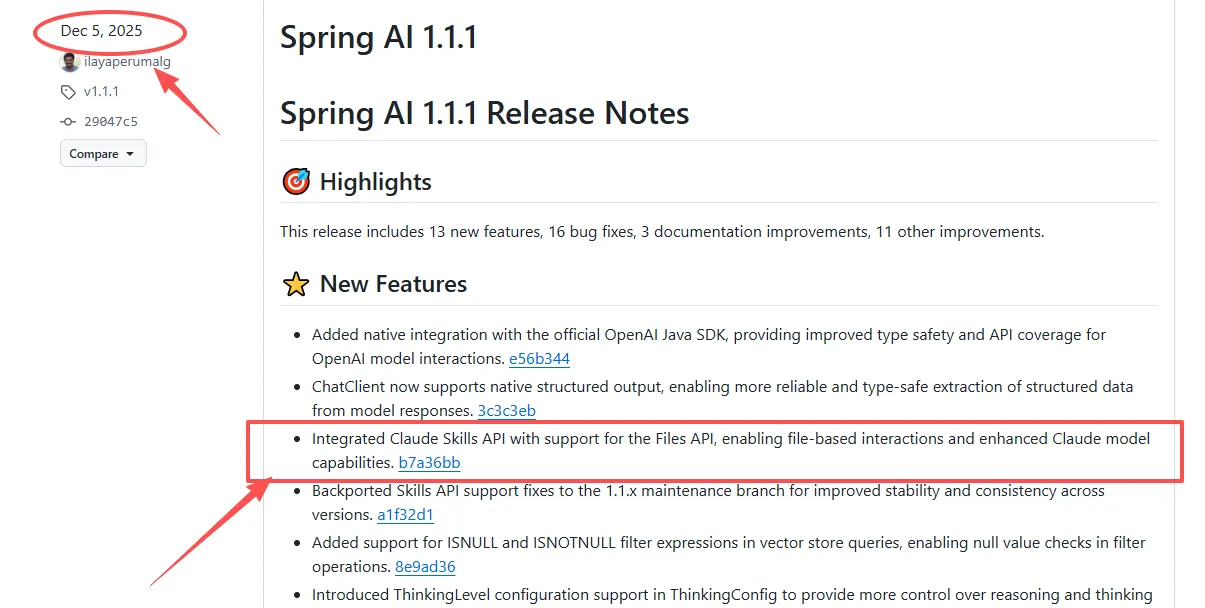
Code、Agent、AI Infra、AI engineering framework(Spring AI)
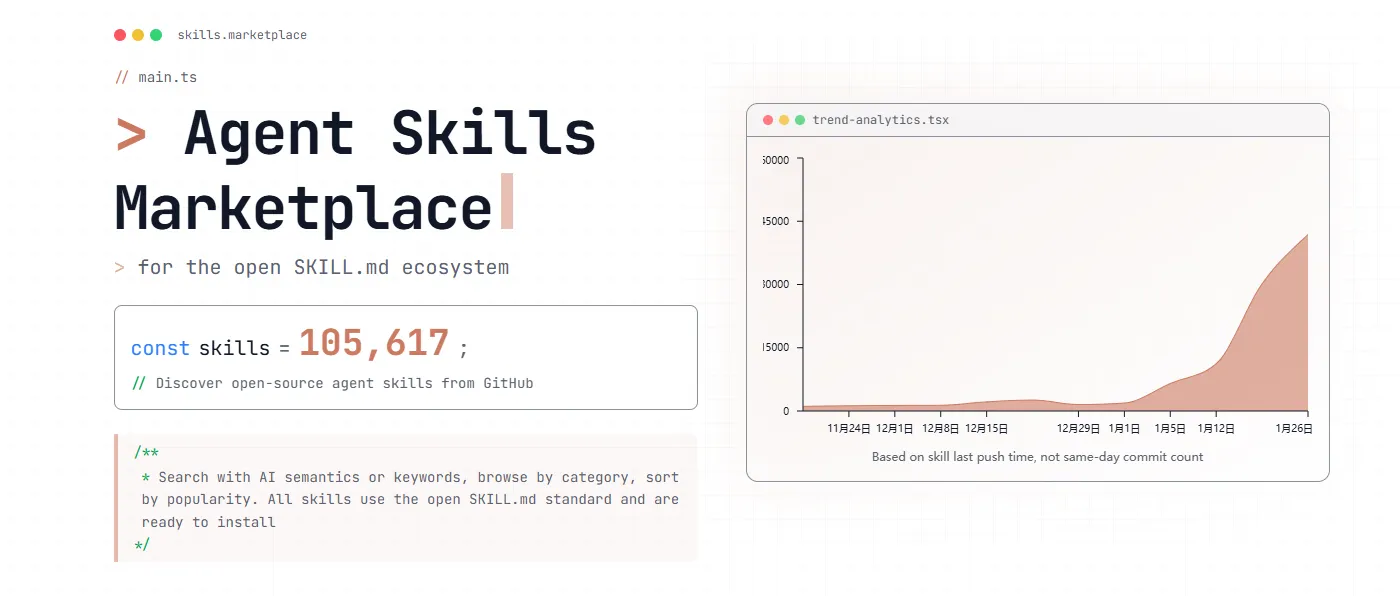
Skill 市场/平台:
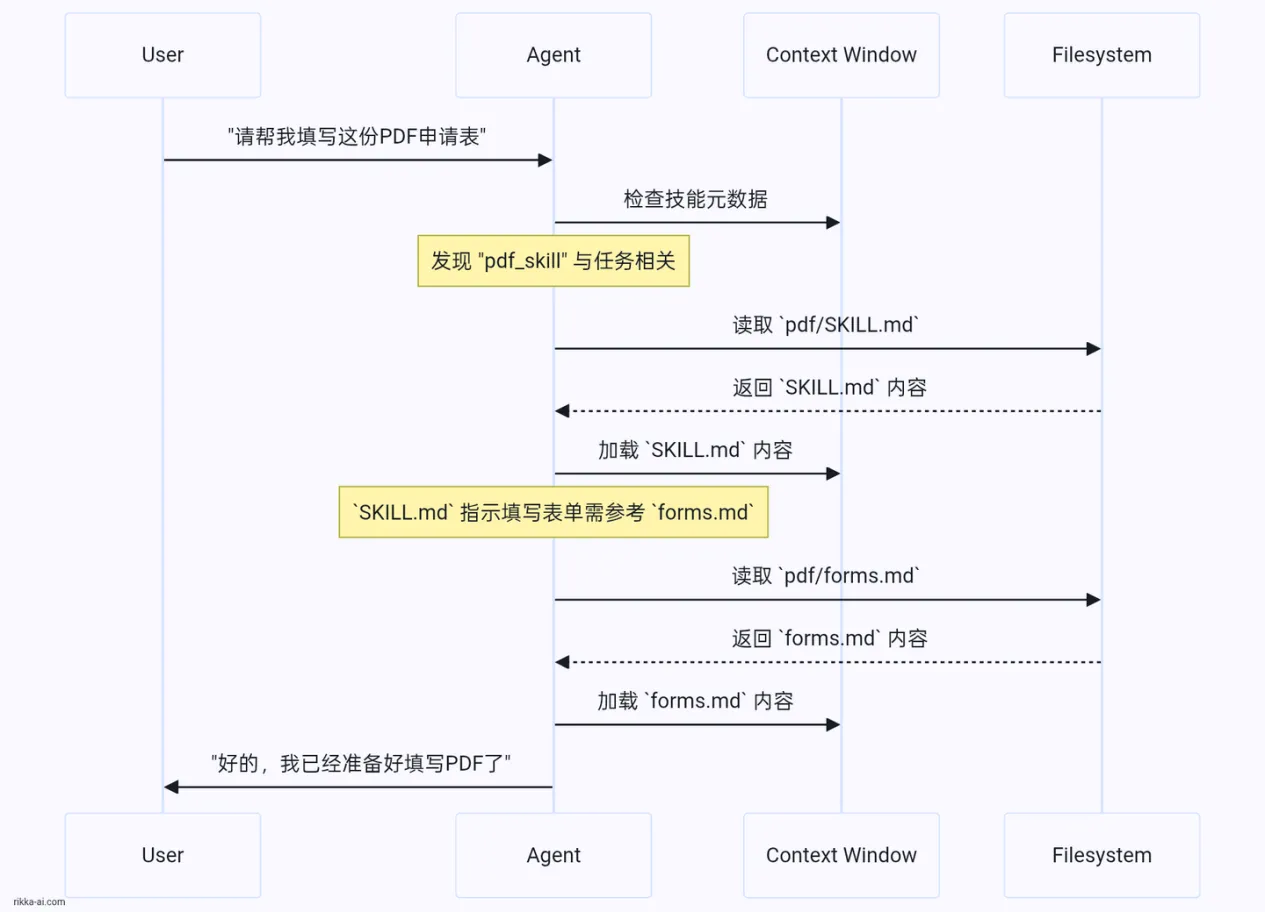
Agent Skills 工作原理
Progressive disclosure context + VM environment
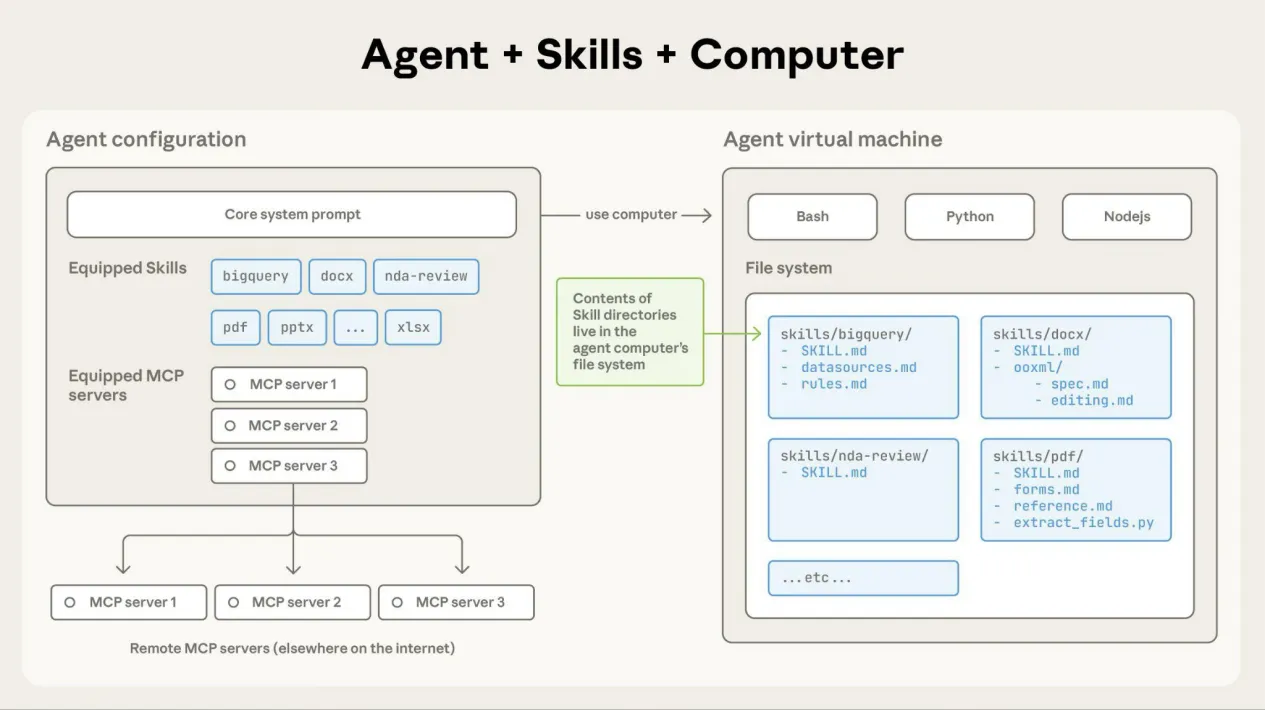
Progressive disclosure context
- Level 1: Metadata (always loaded in system prompt)
--- name: pdf-processing description: Extract text and tables from PDF files, fill forms, merge documents. Use when working with PDF files or when the user mentions PDFs, forms, or document extraction. --- - Level 2: Instructions (loaded when triggered)
# PDF Processing ## Quick start Use pdfplumber to extract text from PDFs: import pdfplumber with pdfplumber.open("document.pdf") as pdf: text = pdf.pages[0].extract_text() For advanced form filling, see [FORMS.md](FORMS.md). - Level 3: Resources and code (loaded as needed)
pdf-skill/
├── SKILL.md (main instructions)
├── FORMS.md (form-filling guide)
├── REFERENCE.md (detailed API reference)
└── scripts/
    └── fill_form.py (utility script)
| Level | When Loaded | Token Cost | Content |
|---|---|---|---|
| Level 1: Metadata | Always (at startup) | ~100 tokens per Skill | name and description from YAML frontmatter |
| Level 2: Instructions | When Skill is triggered | Under 5k tokens | SKILL.md body with instructions and guidance |
| Level 3+: Resources | As needed | Effectively unlimited | Bundled files executed via bash without loading contents into context |
关于 Agent Skills 一些想法
Q&A
-
MCP(尤其针对 Prompt 和 Tool) 与 Agent Skills 什么关系?
- 二者诞生方式、环境相似
- 官方说法:MCP 负责执行,Agent Skills 负责指导调度
- 功能上二者并非绝对互斥,但从应用/逻辑层可以将二者隔离开
- MCP 号称模型上下文协议,在其推出和发展过程中逐渐变成了模型上下文交互协议,而 Agent Skills 更像是模型上下文指挥协议
-
如何看待Agent Skills与LLM记忆的关系?**
- 可以认为是一种基于过程知识的记忆
Skills extend Claude’s capabilities by packaging your expertise into composable resources for Claude
- 目前更多基于先验/实验设计 Skill,手动写入系统
- 后期有做成全自动化的想法,且大概率已经在初步尝试
Looking further ahead, we hope to enable agents to create, edit, and evaluate Skills on their own, letting them codify their own patterns of behavior into reusable capabilities.
-
为什么 Anthropic 要推 Agent Skill?
- 代码场景中派生出来的抽象,和 MCP 相似,觉得不错就往外推了
- 缓解 MCP 设计时候忽略的工具/上下文爆炸问题
- 相较于 MCP 的宣传,Skill 着重强调了 Token 消耗
- 理论上 MCP 也能实现类似 Skill 的功能,其可以扩展 Prompt 规范和使用指导给 McpServer 补充新的功能
- 但其没有在 MCP 上补全,而是选择新开标准,可能因为:
- 功能上二者并非互斥,但从应用/逻辑层可以将二者隔离开
- 所有人都需要新概念
- 不愿承认 MCP 设计不完善
- 为自进化 Agent 铺路(感觉 Agent 一直是 Claude 的优势和发力点)
- 所有人都需要新概念,把盘子做大
-
如何看待观点**“Skill 是 Claude 不愿承认其 MCP 设计缺陷的产物”**
- 有一定的道理,但尚无法定论
- 相较于 MCP 的宣传,Skill 确实着重强调了 Token 消耗
- 功能层面 MCP 确实具备覆盖 Skill 功能的能力
- 但也不排除其在为自进化 Agent 铺路(感觉 Agent 一直是 Claude 的优势和发力点)
-
如何看待各公众号常见标题 “不要搞 agent 了,现在流行 skills”, “no Agent, Skill Now”
- 完全错误,标题党,二者不是一个层面的东西(这种标题的公众号建议直接拉黑,以免以后看到浪费时间)
- agent 的开发是完整的系统工程(重量级),相比之下 skill 更轻量级的增强(插件)
- agent 通常是领域/方向级的,而 skill 更多是任务级
-
如何看待观点 “skill 可能会和 mcp 一样,开发者远大于使用者,造出一大堆没人用的轮子”
- 从个性化(针对个人/企业/组织)的角度,只要能复用就有价值
- 从复用比例角度,skills 的成本更低,因此复用比例大概率比 mcp 更低
Conclusion
- user-tailor 的上下文工程
- Anthropic 风格强烈
- 贴合其 Code can do Everything 理念
- 基于文件系统的存储形式,简单但也直接继承其的优越性,很符合程序员思维模式
最初应该是Cluade的特色(记忆、插件等都在用该方案)?现已经被很多Agent沿用
- 与 MCP 感觉类似,像是从 Coding 场景中派生出的抽象
- 相较于 Agent,Skills 更像是轻量级的工具/workflow
- 暂无法确定是中间产物还是最终形态(个人比较倾向于前者)
Viewpoint
- 单纯跟支持 skill 并不难,难的是将相关组件完善,让其真正能用、好用(包括 exec sandbox、Skill Creator 等)
Skill Creater就不用说了,而执行沙盒即便Claude现阶段也还存在很多限制(估计主要是安全方面,顺带一提,目前mcp实际在安全层面也有很多待完善的点)
- 技术积累/产品爆发是没有捷径可走的,所有偷的”懒”都会成为将来的”债”
比如,如若没有llm Coding的积累,skill Creater想做好不是一件容易的事
- AI/LLM 肉眼可见的带来了一大波行业制定行业标准/规则的机会
- 目前 LLM 相关赛道产物,突出一个”绝对快,相对准”。只要提出想法,就会有人帮你实现/创造应用场景
- LLM 的卷也促使头部厂形成了不同 style 分化(claude-编程,google-多模,deepseek-数学/工程),跟进/创新需要思路明确,全跟是不太现实的